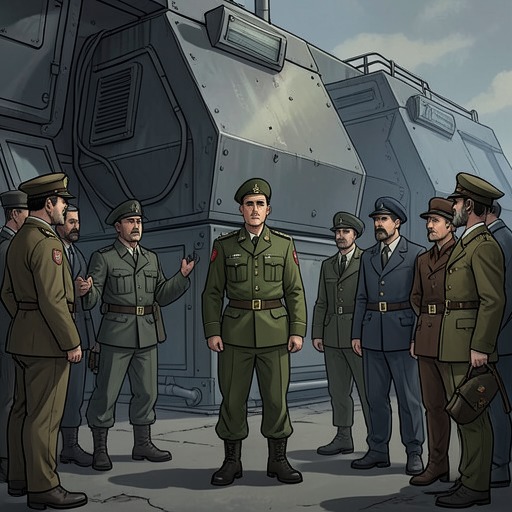
Federation High Court
Stranger in a Strange LandThe Federation High Court is the institution whose ruling in the Larkin case established a major precedent for planetary ownership and colonization. Its decision resolved a dispute over the Moon by rejecting a corporation’s claim and recognizing the human occupants as sovereign, but the novel shows that applying this precedent to Mars is far less straightforward: Mars is inhabited by Martians, whom terrestrial law does not yet recognize as legal claimants.
The Larkin Decision
The Court’s role is explained through a history of competing lunar expeditions. After earlier Russian and joint American-Canadian missions, General Atomics sent its own expedition from an island leased from Ecuador. Its men remained on the Moon when the Federation vessel arrived, followed by a Russian one. General Atomics, a Swiss corporation under American control, then claimed the Moon.
The Federation could not simply dismiss the corporate claim without aggravating the political situation, particularly because Russia would not have accepted such a move. The High Court instead ruled that a corporation, as a legal fiction, could not own a planet. The actual owners were the people who had maintained the occupation: Larkin and his associates. The Court recognized them as a sovereign nation and brought them into the Federation, alongside concessions to General Atomics and its subsidiary, Lunar Enterprises.
The ruling was a compromise rather than a universally satisfactory settlement. The High Court was not yet all-powerful, and the arrangement included concessions to parties with competing interests. Nevertheless, the decision became part of planetary law and informed strict colonization rules intended to prevent bloodshed. The account connects those rules to the fact that the Third World War did not arise from conflict over space travel.
The Mars Question
The precedent matters because Valentine Michael Smith’s claim to Mars could, under terrestrial law, make him a sovereign nation in his own right and the planet’s sole owner. The Court’s earlier ruling is therefore not merely an episode in lunar history: it supplies the legal logic by which Smith’s extraordinary status can be asserted.
But the analogy has a decisive weakness. The Moon was uninhabited when Larkin and his associates occupied it; Mars is inhabited by Martians. In the political and legal circumstances described, Martians count as legal nonentities. The High Court might nevertheless reconsider whether human occupation can establish rights on a world already inhabited by nonhuman natives. If it concluded that the Larkin Decision did not apply in those conditions, any human rights on Mars would have to be secured from the Martians themselves.
Precedent and Its Limits
The discussion contrasts the legal fiction of planetary ownership with the prior existence of a people and their own customs. The analogy offered is the Pope’s fifteenth-century grant of the Western Hemisphere to Spain and Portugal: the grant did not account for the millions of Indigenous inhabitants, their laws, or their property concepts, yet proved politically effective. The comparison underscores that a legal instrument may shape control without resolving whether its premises are just or whether it recognizes those already living on the land.
The High Court’s precedent thus carries two implications at once. It provides a framework for restraining competing human claims and avoiding conflict, yet its application to Mars risks repeating the exclusion built into earlier terrestrial legal arrangements. The unresolved question is whether the Court will treat Martian habitation as a fundamental difference or allow an Earth-derived rule to determine ownership before Martians have any recognized standing.
Institutional Reach and Political Stakes
The Court’s authority is presented as consequential but historically constrained. The Larkin settlement depended on compromise among the Federation, Russia, the occupants, and corporate interests; it was not an uncontested exercise of judicial power. Its later incorporation into planetary law gives the ruling durability, while the possibility of a new interpretation makes the Court a potential arbiter of Smith’s claim and the competing human interests surrounding Mars.
A conversation about the Secretary General’s political position makes the stakes explicit. If Smith died, his peculiar claim might disappear, and the human pioneer group left on Mars by the Champion could advance a new claim. The High Court might then decide that human occupation has no force on a world already inhabited by Martians. That possibility makes the Court’s interpretation matter not only to title, but also to whether Martians can be treated as parties whose consent is necessary.
The novel therefore presents the Federation High Court as both a maker of workable law and the institution that may expose its limits. The Larkin Decision offered a compromise intended to keep human expansion from becoming a source of war; Mars tests whether that compromise can account for a world whose inhabitants were excluded from the legal framework from the start.